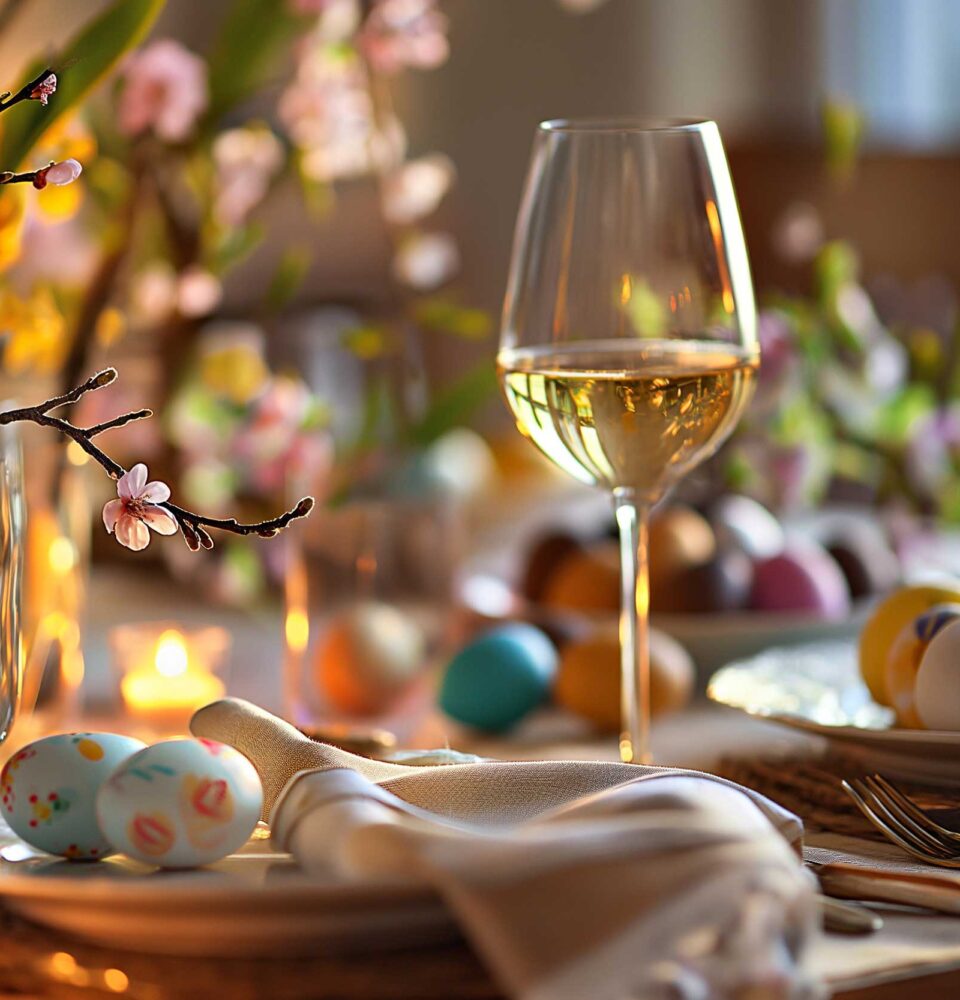

Easter has always been, in our minds, the most important celebration of the year. Not because we don’t love Christmas—but because Easter is intrinsically linked to rebirth. It is the feast that sits at the heart of spring, the harbinger of carefree days and summer ahead. It is the celebration through which nature reveals itself in its most fertile, generous form.
Mageiritsa, eggs, cheeses, tsoureki, lamb—and all the traditional flavours of the Easter table—make the choice of wine anything but simple.
Wine Illusion is here to help you solve the wine riddles of this festive season.

Eggs
Avoid wine.
But if you’re feeling particularly glamorous—and you don’t mind a hint of “egginess” in the glass—go for a Champagne.
Mageiritsa
Loved by some, loathed by others—yet undeniably one of the most flavourful and generous soups in Greek cuisine. Dill lends a herbal profile, while offal and avgolemono define its unmistakable character.
A Syrah would be the safest and most satisfying choice.
If that’s not to your taste, opt for a tank-fermented Santorini Assyrtiko with the highest possible acidity.
Lamb
Here, tannins and vibrant acidity are essential to cut through the richness of the fat.
Xinomavro from Naoussa creates a truly fetish-worthy pairing.
Equally compelling is a Piedmontese Barolo, if you can handle its structure and intensity.
Cheeses
Fresh goat cheeses
Choose an aromatic white with sharp acidity, such as Sauvignon Blanc from the Loire Valley or New Zealand.
Soft white cheeses (e.g. Brie)
A light, very dry red such as a Burgundy—or alternatively, a dry Sauvignon Blanc.
Blue cheeses (Roquefort, Stilton, Danish blue)
Counterbalance their fatty, salty intensity with a powerful sweet wine: Vinsanto from Santorini, Sauternes, or a good young Vintage Port.
Parmesan
For heaven’s sake—do not open your finest red.
Opt instead for a very dry Champagne.
Fresh creamy cheeses (e.g. mozzarella)
Light, dry whites such as Soave or Muscadet from the Loire.
Hard and semi-hard cheeses (e.g. graviera)
A rich, oak-aged white like Chardonnay, or a medium-bodied red such as Nemea.
Aged hard cheeses (excluding Parmesan, e.g. aged Gouda or Cheddar)
This is where you open your good Bordeaux—or any other robust, structured red you’ve been saving.
Tsoureki
With its intense aromas of vanilla and mastic, tsoureki calls for sweetness.
A white Muscat from Samos or Lemnos is your best match.
And if, after a marathon of food and sensory indulgence, a gentle melancholy sets in—remember this:
Easter is only the beginning.
Fasting is over. The pleasures are just getting started.